Category: Promoted

Usually stuff I’ve written personally, stuff I think is pretty good.

  • Relay for Life 2012

    Another year, another relay.

    After seeing a great tilt-shift time lapse by a guy in Melbourne, I thought it would be time to try my hand at time lapses, and what better event to do it at other than the Relay for Life 2012?

    The original plan was to do a tilt-shift time-lapse in the same style, but then I found out that a lot of the work would have to be done in post. The way the guy did it in the video was with his Canon S95, a great little point-and-shoot. Turns out, the S95 does it pretty much automatically… Not fair!

    With only a DSLR an still wanting to do time-lapses, I decided to acquire some gear.

    First on the list: a GoPro. Truth be told this could have been anything with a built-in intervalometer, but I wanted to try a GoPro. In past years we’ve had a pram going around the track for close to 24 hours straight, so I thought making a time lapse of the event that way would be kinda cool. I borrowed a GoPro from my boss, and that was that.

    During testing of the GoPro a few days before the event, I discovered it only had about 3 hours of battery life. I wanted to do a continuous time lapse of 24 hours, so I needed a way to power it. Cue external USB battery pack with massive 10,600mAh capacity and 2.1A output. The GoPro has a battery capacity of about 1,100mAh, so I was covered there.

    The GoPro would cover me from ground level, but I still wanted to do some kind of a tilt-shift one lapse. Or at least another time lapse from another vantage point. To that end, I borrowed a time lapse camera from a friend, a dedicated time lapse unit that was designed specifically to take time lapses of plants. The plan was to mount this unit somewhere up high, looking down on as much of the area as possible.

    Finally, I borrowed a smaller point-and-shoot with a built in intervalometer from a colleague for even more time lapses, just in case things went pear-shaped with either of the other cameras.

    With four cameras (three for time lapses and my own DSLR), I think I was ready for whatever was going to happen at Relay.

    So, how did it all turn out?

    Hobart Relay for Life 2012 Time Lapse

    The GardenCam got knocked about a little. You can see in the video above, it changes angle a few times, the quality isn’t great, the focal length is too long, yada yada. The positioning could have been better, but then mounting it would have been a pain. As it turns out, the GardenCam has a very slight (completely unintentional) tilt-shift effect — but I think that’s more the camera being completely crap at focusing rather than anything else.

    The GoPro worked out pretty much exactly as I thought it was going to, but the end result wasn’t as spectacular as I thought it was going to be. Maybe a photo every ten seconds was too long in between shots, but the resulting time lapse has parts where things just shoot by at a rapid pace.

    For a time lapse to look good, you’ve got to have a nice connection between the shots. If the camera itself is moving (as mine was), then maybe shots more often is a good thing. I have a hunch that less FPS during the final movie (the 10-15fps mark, slower playback speed) in the final movie works better for time lapses with a fixed camera. Take more photos with a moving camera, speed up the FPS in the final movie (24-30fps). But then again, a lot of this is just pure guesswork on my part — you’ll just have to experiment to see what looks good1. Next time I would probably err on the side of taking more photos and varying the speed of playback in post — you can’t go back and re-take photos on the day, but you can cut out stuff in post.

    Definitely worth looking at again.


    1. I hate posts on creative subjects that say “just do what you think looks good”. “Just play with the sliders until it looks good.” “Just tweak the exposure until you get it just right.” WHAT DOES THAT EVEN MEAN? Give me direction any day: “play with the exposure until you get something that isn’t too overexposed, but at the same time brings out the colour.” If you’re going to say “just play/experiment”, give the person a little direction as to what they’re aiming for, and what they’re trying to avoid. 
  • Mass Effect 3

    Now that I’ve finished my first playthrough of ME3 and grinded my way through some multiplayer, I’ve been sitting on a second playthrough for about a week now.

    That is to say, I’ve started my second playthrough, but haven’t actually played any of it yet. A FemShep, Vanguard, Paragon, if you must know.

    The way I’ve played all three Mass Effect games thus far is that the first play through is always using the default male Shepard, with all choices made as I would make them. Usually this falls on the Paragon side of things, with decisions made as I would make them (with perhaps a bit of divination as to what might happen in the future). Many people play Mass Effect like this, as it is, after all, a role-playing game.

    The second play through is a little more relaxed in terms of choice. It’s the play through that lets me experiment with different choices, as well as allowing me to be a hard-ass Renegade where I believe it’s required. The second play trough is usually played as a female Shepard, too, just so I can experience another level of voice acting and see the difference between the two Shepards.

    Then the play throughs get a little murky. I only completed the above two play throughs on Mass Effect 1, but for Mass Effect 2 I started a third play-through, a pure Renegade FemShep. Never got around to finishing that, because my interest at that point waned (not too unexpected when you’ve already completed the 30-hour storyline… twice).

    Now that the background is all out of the way, I can tell you why I haven’t brought myself to continue my second play through of ME3 beyond the first priority mission.

    It’s about choice.

    You see, dear reader, Mass Effect is all about choice. The Mass Effect series has always been about the choices you make as a player, as male or female Commander Shepard. And that’s why I can’t bring myself to play Mass Effect 3 any more than once.

    Let me explain: in the first two Mass Effect games, you have lots of choices to deal with. Some of those choices carry across to the second Mass Effect game, and some of the decisions you make in ME2 carry across to ME3, and so on. Lots of choices, like, literally, quite a few — so many that it’s reported over 100 variables are carried across from Mass Effect 2 to Mass Effect 3. As an aside, the whole concept of continuing the same character across games is a brilliant, ingenious concept that I really think more games should adapt: rewarding players for hanging onto their save files so they can continue the story in future titles is nothing short of brilliant, and doubly so in a role-playing game centred around the story. There are small issues with this approach, one being that there isn’t a way to “confirm” your choices in later games (in case you lose your save file); what I’d love to see is some kind of prologue to each game that makes you make those decisions again, but I can see how that would potentially sour the game for many. Tough call, but I digress.

    Okay, so back on track: Mass Effect forces you to make choices. Not necessarily decisions between good and evil, but more subtle decisions: sometimes the decision between being a nice guy and a ruthless hard-ass isn’t as clear as some of us would like it to be. Like whether to free the Rachni queen. Or whether to keep a mad Salarian scientist’s work on curing the Genophage. Or killing Urdnot Wrex on Virmire. And so on and so forth; as a player you’re never sure how the outcome of your decisions will turn out. It keeps you guessing throughout the series, and it’s great.

    Now, here’s where it gets interesting: for the most part, you had no idea how these decisions were going to affect future games. Maybe your act of goodwill in letting the Rachni queen live will come back to bite you in the arse in a future title. Maybe Urdnot Wrex turns out to be indoctrinated, I don’t know. The thing is, in the first two titles of the Mass Effect trilogy, you pretty much can do whatever you want without there being too drastic consequences (at least, not consequences you care about, not consequences you actually know about).

    Mass Effect 3 changes all of that. Suddenly, you know what the end-game is. Suddenly, your decisions will weigh heavily on you, moreso if you made the “wrong” decision somewhere along the line.

    Being the third title in a trilogy must be pretty hard. Even before you rip open the packaging, you know that this is it. After this, there’s not going to be any of a series you have some kind of a vested interest in, emotionally or otherwise. You know that after this, there will be no more. It’s the final countdown. The end of days. The beginning of the end.

    Which is why, as you make your choices in Mass Effect 3, you make them damn carefully. Unless you’re some kind of sadist who doesn’t care about the story at all, you’re going to try and get the “best” ending possible. You’re going to try and make peace with everyone. You try to “do what’s right”, to play the hero Shepard everyone seems to think you are. So many times during Mass Effect 3, I sat there for minutes on end, staring at that little dialog choice circle, agonising over the choice I had to make. Because short of saving right before and reloading saves (a practice somewhat frowned upon), there’s no going back. What choice you make will either be the right one, or haunt you until the very end. There’s no sense in being a ruthless, at-all-costs Renegade, because even though you might get the job done, you’re not going to make many friends along the way. And that, ladies and gents, could affect how it all plays out in the end.

    Which brings us, somewhat nicely, to the section wherein I talk briefly about the ending that everyone seems to be so upset over. People have petitioned Bioware over the ending in Mass Effect 3, and rightly so, in my opinion. Gaping plot holes and non-sensical cut-scene theatricals aside, the ending is so incredibly unsatisfying it’s an embarrassment. Unsatisfying is probably too light a word; if I’ve invested over a hundred hours into a series of three games spanning a number of years, I want the ending to be to my satisfaction. I’m all for leaving the reader guessing at the end, but the ending of Mass Effect 3 just doesn’t do the rest of the trilogy justice. It’s almost as if Bioware just ran out of time and/or money to put together something as stellar as the rest of the series, and now we have… The Ending That Shall Not Be Discussed. I mean, this is the culmination of everything you’ve been working towards ever since the first Mass Effect, and for what? I wish I could say something other than “a wholly unsatisfactory ending”, but I can’t.

    Yes, it could probably be argued that the entirety of Mass Effect 3 is the ending to the Mass Effect trilogy, and in some respects you’d be absolutely correct. That’s not the point though, the point is that the climax of one of the most anticipated games this year, not to mention the entire series, feels like a complete and utter let-down by Bioware. They dropped the ball on this one; not just a small fumble, a complete and utter shambles.

    Phew. The good news is Bioware has apparently caved and are planning to re-work things a little. Exactly what that means is still up in their air, but at this stage I’d be prepared to DLC my way to a better ending, whatever that might entail. Bioware, are you listening? I’ll gladly pay for a better ending, one that’s worthy of flying the Alliance flag.

    But you know what? Mass Effect 3 is still a fantastic, triple-A title. As a whole, Mass Effect has evolved a little throughout the series, but only to culminate in what is easily the best game of the year thus far.

    It’s a passable third-person shooter with quite a decent wave-based co-op multiplayer reminiscent of Left 4 Dead’s survival, or Horde mode in Gears of War, that also features objectives every few waves. The single campaign is where it’s at for the majority of players though, and that’s where Mass Effect shines. The storyline is unparalleled, the pacing, fantastic, and besides that ending that we really shouldn’t be talking about, it has very few, faults.

    I’ll admit, there were many times during Mass Effect 3 that I felt something. Reunions with past squad mates in the previous game are particularly heartfelt, as is hilarious dialogue with likeable characters. Mass Effect 3 has managed to pull off one of the hardest hitting emotional aspects of any game I’ve played, and it does it so well. There were times during the game that I sat back and thought: hey, why don’t more games do this? Or, I love how this game manages to evoke some kind of response from the player. The down time between missions isn’t as frantic as the main storyline, and there are periods where you’ll be standing around on the Citadel trying to work out where you’re going/doing next, but it’s all good. All part of the package, if you will. Mass Effect 3 is, in my opinion, the pinnacle of gaming today, whether you think the ending sucked or not.

    Mass Effect 3 is the very definition of Role Playing Game, with one of the most epic plots that’s as engaging as it is compelling — triple that if you’ve played the previous games; if you get sucked in, hang on and take a deep breath — you’re in for one crazy ride.

  • Bored

    It’s something that has been mentioned a couple of times before by many people, but it’s still an important point, and in 2012, just as relevant as it has been before.

    It’s boredom.

    Or rather, the lack thereof.

    When was the last time you were truly bored?

    In this day and age, in the smartphone era, we’re always connected. People actually prefer to have their emails pushed instantaneously to their phone, rather than waiting a few minutes for that email to come in. We have this “streaming” technology on Twitter that means we’re not just taking a sip from the stream, but taking a water cannon in the face.

    Technology means we have Kindles for reading, Nintendos for gaming, and iPhones for pretty much anything else. It’s crazy to think we live in a world where fast, free Wi-Fi is almost ubiquitous, and mobile networks more so again.

    Don’t get me wrong, I love technology. It connects people in ways we never imagined, and means any number of friends and other humans are always just a short few taps away. And hey, it even does an admirable job of keeping people like yours truly awake in lectures.

    Think about it: when was the last time you went without staring at some array of pixels for some amount of time? If you’re not looking at your computer, you’re looking at your phone. Or playing with your iPad. Using a digital camera. And so on, and so forth.

    The question then becomes: where and when do we draw that line in the sand and say: “hey, I just need a moment to myself.” A little alone time, time away from Twitter, time away from Facebook, time to just sit, think, and contemplate the meaning of life, the universe, and everything?

    Not even thinking about anything in particular. Just the chance to have a little down time every now and again. The chance to get offline.

    I don’t drive, so as a result I do my fair share of public transport. I used to enjoy doing a little bit of writing on the bus, and I still do, but increasingly I’m finding that I just put my in-ears in, start playing some great music, and tune out. Tune out is the best way to describe it, because you don’t have to think about anything.

    It’s very nice.

    Because as much as I enjoy technology in every aspect you can imagine, I think it’s supremely important to get away from it all for a while. You can’t be always switched on, all the time; it gets tiring pretty quickly, and I dare say you’ll suffer from burn out sooner rather than later.

    So stop reading your RSS feeds for a weekend. Stop feeling like you have to check Facebook religiously. Stop succumbing to the pleasures of the Internet and just disconnect.

    Enjoy the serenity, while you still can.

  • Circular polariser experimentations

    Two photography posts in a day! Amazing!

    I took a circular polariser out today for a spin to see what all the fuss is about. I’ll save you the trouble of reading something long-winded, if you’re so inclined: useful, but I don’t think I’ll shoot with it everyday.

    It was kinda funny, actually — this was my first time out with a polariser, and I had really no idea what it could do. I must have looked like some crazy dude on multiple occasions, looking through the viewfinder and rotating this thing on the end of my lens like a fool, pointing it towards the sky or towards a window to see the effect that it has.

    And what an effect.

    shop window with circular polariser
    shop window with circular polariser

    The difference is pretty clear — with the polariser, you almost entirely eliminate reflections on windows. It’s also supposed to make the sky more blue, but I couldn’t get that to happen an extreme amount.

    building and sky with polariser
    building and sky without polariser

    Nice and all, but I don’t think I’ll be shooting with it all the time, at least not to start off with. Takes too much time to compose, for one — compose the shot, spin the polariser, spin the polariser some more, take the shot — by which time your subject has either long gone or the moment has passed. Still, I can definitely see where it will be useful for landscapes and the like.

    Also: if you look closely you can see a tiny bit of pretty extreme vignetting in the corners of those shots. It’s not bad, and can mostly be corrected in post, but it’s still there.

    Anyway, yes. So sometimes you go out shooting, right. Week 1 of the Uni semester is great for this because you don’t have tutes to attend, and can spend most of the day wandering around taking photos, right. You take a walk, and sometimes, you only take a handful of photos. But almost every one of those photos are great. I don’t even know what it is, maybe you spend more time composing, more time thinking about the shot, more time actually taking shots you want to keep rather than just shots you would like but don’t turn out very good…

    And then, other days you go out shooting, take hundreds of shots, and end up with a single shot you actually like. Maybe it’s because you’re thinking more about how the circular polariser affects the shot, maybe it’s because you’re not even thinking about shots you want and just shooting to see what kind of an effect the polariser has. And the kicker, the kicker is that the one shot you do like was the most balls-y, most not-even-thinking-of-the-polariser shot of the whole hour or however long you were out shooting for.

    That one shot where you saw someone sitting on a ledge, minding their own business.

    The one shot where you got right up in some guy’s business, aimed the camera at him, put the viewfinder up to your eye — and by that time he’s definitely noticed you, but there’s no time to back out now — you half-depress the shutter to focus, you compose the shot —  the guy is smiling, realising what you’re doing by now (as if it wasn’t already obvious) — and you take the shot.

    By the time you finish the shot, the guy has a huge grin on his face. He’s laughing, even. You thank him, and keep walking.

    Best photo of the day. That one, single moment where it all comes together.

    And it completely blows your mind that it was so easy! I mean, all this time you’ve been telling yourself that people are just going to flip out when they see someone taking their photo, that they’ll rant and rave about some crazy privacy, make a huge scene and kick up a massive stink. It’s the one thing that’s been holding you back from the kinds of street you’ve been wanting to take, and all you needed was some guy on a ledge to smile as you were taking the shot and not flip out completely.

    I love photography.

  • A little more light, please.

    really bad photo, but I'd love to experiment with a strobe more

    I don’t know whether I just need more time behind the lens, or whether I’m just pixel-peeping more than I should be, but so much of the time I’m unimpressed with my photography; street or otherwise.

    Technically, photography is incredibly complex. So much depends on the three pillars of aperture, ISO, and shutter speed, and when you’re starting out (because, make no mistake, I am still very much an amateur) getting them right to suit the conditions is hard.

    So much of the time it’s like the three pillars are the world’s most intricate balancing act. Say you’re shooting people in an area where there isn’t much light. You start off in Av, at f/2.8 with an ISO of 100 — the camera says you’ll need 1/8th of a second, which means camera shake then becomes a factor. Upping the ISO above 800/1000/1250 means you have a more respectable shutter speed of 1/30, maybe even 1/60, but even at those speeds a shot can still be ruined by subject motion. In this kind of situation, what can you really do without adding more light into the equation? More ISO means your photos are starting to be fairly grainy indeed, and you can’t open the aperture any more because you’re already at the limit of your lens (or you want the DOF because nailing focus is hard, etc). Photography in these kinds of situations is seriously challenging, and it’s times like these that make you think: “hey, this stuff isn’t just child’s play”.

    Being a perfectionist is hard when you’re doing photography. I’d like to think my composition is good enough most of the time, and yet, when I’m looking at my photos in post at 100%, I’m sorely disappointed to see things aren’t as sharp as I wanted them to be, or that I’ve missed focus even though it looked okay on-camera.

    I don’t even know why I crimp shots when I’m shooting — things on that back LCD look so much different than they do when I’m looking at the photos 100% on the computer, and even things that look okay on-camera can turn out to be extraordinarily average when viewed 1:1. In any case, crimping shots is a really bad habit that I’ll try to break.

    It’s like Ira Glass said: I know I can do so much better. I know I can improve, it’s just that when so much of my shooting is extremely mediocre, it’s depressing as anything.

    It’s somewhat ironic that the only place where I am improving is post-processing. I can now do simple stuff like split toning in Lightroom, and I can even do that Schindler’s List black/white/red effect in Photoshop (I think Sin City also used this effect), as well as selecting the black and white points of a photo in Ps.

    To be fair, I don’t really have a good idea of why you would want to do those effects, or how to describe the effect, and for now, my understanding of it is limited to “it looks cool”. I disgust myself.

    I guess most of this dissatisfaction with my own work stems from being very well versed in a particular subject area; computers are easy for me, and I understand them well enough to be able to explain most concepts to anyone. Don’t get me wrong, photography is fun, taking photos is fun; doing it well and with understanding is something that I’ll just have to work on.

    But doesn’t that come hand in hand when learning something new? Everyone sucks to begin with; some people then quit, but others go onto future greatness.

    At the moment I’d settle for consistently mediocre, but I think I’m getting there. Slowly.

    some dude flippin' a water bottle
  • Electronically Capturing Light

    Yes, photography. Another day, another lens.

    Wait, what?

    I have a confession to make. I’ve been suffering from GAS (Gear Acquisition Syndrome, for the uninitiated) for a little while now, which results in me buying lots of things. Perennially bad for my wallet, but somewhat satisfying. What good is money if you don’t spend it?1

    My newest glass is the arguable best of EF-S lenses for crop-sensor DSLRs, the EF-S 17-55 f/2.8 IS USM. I didn’t find the DigitalRev hands-on to be all that informative (strange for them, their videos are usually top notch when they’re not fooling around doing stupid things like “horsemanning”).


    Of course, this meant that I had to try it out. More street, anyone? The location: in and around the Hobart CBD. It was a pretty overcast day which normally would have been fine for a bit of outdoor street, but it started to drizzle heavily a little later on which meant I didn’t go for a serious walk up to North Hobart like I was originally planning to. The best laid plans, and all that.

    Initial impressions of the lens: it has a pretty big lens hood (not included). The focal length ring is incredibly, incredibly smooth; there’s a tiny more friction in the 17-35 range than there is in the 35-55 range, which makes it very nice to use. The IS and AF switches have a nice, audible “click” when you move them, and the focal ring is equally smooth when you’re changing the focus, and slightly more resistive when you’re past the focal range adjustment. I honestly can’t fault it as a piece of engineering, bar for the fact that it’s slightly larger than I expected (both length and girth-wise), but I guess that’s part of the parcel when you have quality glass.

    It is, in a word, excellent. Most of my flawed photos were simply and error of the guy behind the glass overestimating his abilities to take a good photo — or just simply failing to take a good photo. By my own account, I think I’m at least okay with the whole composition thing — it’s just taking the shot like I see it in my head that’s hard (well, of course it is).

    Choosing this lens was difficult, to say the least. I already have comparable lenses that do the same focal range — my Sigma 30 1.4, for example, covers the same distance provided I take a few steps forward or back, and it does this at an even bigger aperture, and I already have an 18-135 which covers the same range, as well as the nifty fifty which does a similar thing to the Sigma. My current collection of glass aside, there were also many great alternatives: the 24-105 f/4L at the top of that list, followed by a few non-Canon alternatives. After taking a few photos with it, I’m pretty glad I chose this lens over something like the 24-105 f/4, purely because it’s a fantastic standard lens for a crop-sensor DSLR.

    Admittedly, the 24-105 does still have a few advantages over the 17-55 — it covers a bigger range and works with full-frame cameras should I ever decide to upgrade, both excellent points to consider. It does have one thing lacking though, and that’s the 2.8 aperture. I think this means that it needs twice as much light at the same shutter speeds as the 2.8, and it might also mean I don’t get as much bokeh as I do with a 2.8 aperture (although, once again, it can be argued that the 24-105 can get more bokeh due to its longer focal length). At least, that’s what I’ve gleaned from the internet.

    If there’s one thing I want to work on with my street, it’s individual portraits. I’m way too hesitant to take photos of individuals or couples when doing street as it can seem a little stalker-ish, a little perverted (if you’re talking photos of the opposite sex), and there’s already a million other things to worry about when doing street. I guess it’s about finding the line between invading someone’s privacy (if only for a moment) and being seen as a pervert — an exceptionally fine line indeed. Taking photos of individuals on the street is definitely something I’m warming up to, but I’m still quite hesitant about it for the reasons posted above. Sadly, for now, it means my photos aren’t of anything particularly interesting. I mean, who wants pictures of just nothing in particular?

    You probably wouldn't want to go where that bus is going, though.

    Now that I think about it, taking photos of random people is hard. You never quite know how they might react, and I’ve read enough horror stories to know what could happen. Worst-case scenarios rarely happen, but I’m still a little freaked out one day someone is going to completely lose the plot when I take their photo and, like beat me up or something. It’s a scary thought.

    Then I see people like this guy doing street photography on the streets of LA, where he gets right up into people’s faces using his Leica M, and people look up, smile, and continue on with whatever they’re doing. Are people much friendlier over there, or is it all about the right approach? Which brings me to my next point…

    Okay, so I’m Asian, right (don’t laugh, this is SERIOUS BUSINESS). On the one hand, I can blend great into any crowd with a decent-sized cam and people will think I’m just another tourist taking pictures of damn-near everything, which is fine. Great, in fact — people don’t think twice about the Asian guy taking a photo of a busker. The only thing is, the whole blending-in thing doesn’t quite work if you’re taking photos of people. I mean, normally you see Asian tourists with their point and shoots snapping away at nice-looking buildings or whatever, and here I am with my giant DSLR aimed squarely at them! What’s up with that?!

    Anyway.

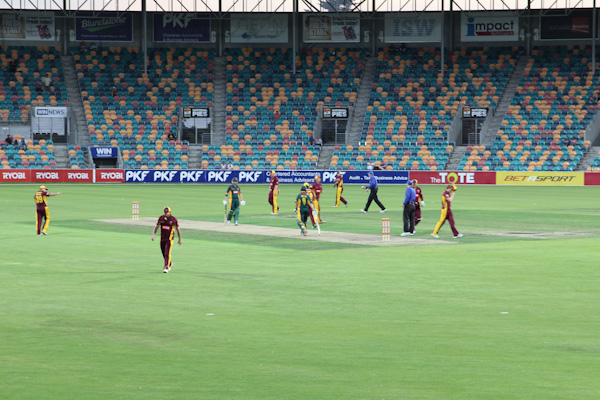
    Lastly (until next time) I went to the cricket the other day. This was at 85mm on a 1.6 crop — there’s a 200mm lens limit condition of entry at that particular ground, but a) I think the guys at the gate wouldn’t be able to tell (or they just didn’t care because it wasn’t an international match), and b) I think you would be able to get a few decent shots of players if you had something like a 70-200 at the same crop factor.


    1. Probably a deeper underlying issue here if I’m going about saying things like that, but that’s for another time. 

Benny Ling's Bling

Computers are like a bicycle for our minds.